Home Products Services Contact
Get a Quote
Dryers

Spray Dryer
(Nozzle / Rotary Disc)

Convert liquid feed into free-flowing powder in a single continuous operation. Available in nozzle atomization and rotary disc atomization designs producing powders with precise, controllable particle size for dairy, food, pharma, chemical and ceramic applications.

10 - 5,000
kg/hr Output
80 - 280 C
Inlet Air
Nozzle / Disc
Atomizer
GMP
Grade Option
Spray Dryer (Nozzle / Rotary Disc)  -  Gausin International Engineers
Single Step
Liquid to Powder

Product Overview

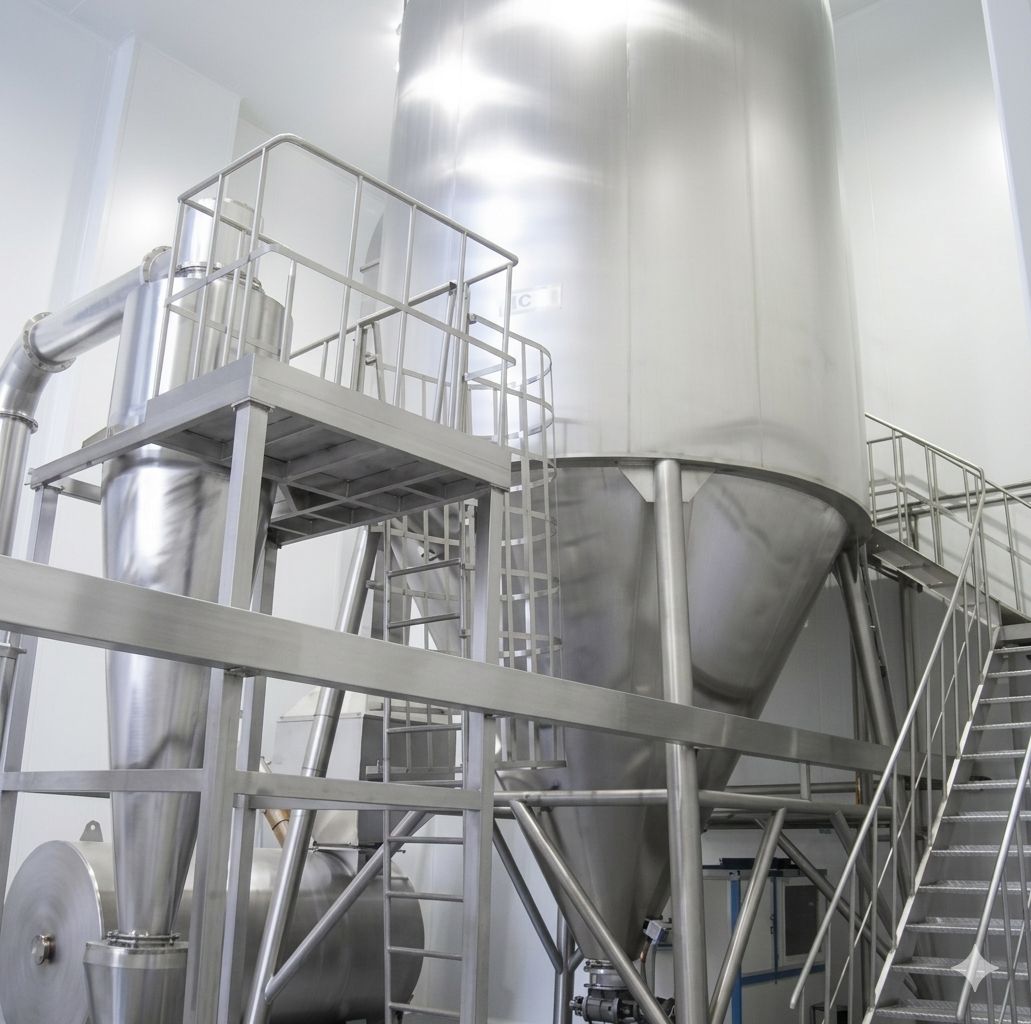
The Gausin Spray Dryer transforms a pumpable liquid feed (solution, suspension or slurry) into a dry powder by atomizing it into a stream of hot drying air. Evaporation is almost instantaneous, so the product is exposed to high temperature for only a fraction of a second.

Two atomization options are offered: high-pressure / two-fluid nozzle atomizers for coarse, free-flowing powders, and high-speed rotary disc atomizers for fine, uniform particle size. Co-current, counter-current and mixed-flow chamber layouts are available to suit the product.

Each plant is engineered with mass and energy balance simulation, cyclone / bag-filter fines recovery, and optional fluid-bed after-drying for agglomerated, dust-free, instantized powders. Hygienic and GMP-grade execution is available for dairy and pharma duties.

Dual Atomization
Choose nozzle or rotary disc atomizers for the exact particle size and bulk density you need.
Instant Drying
Very short residence time protects heat-sensitive products like milk, enzymes and APIs.
Flexible Air Flow
Co-current, counter-current and mixed-flow chamber configurations.
Fines Recovery
High-efficiency cyclones and bag filters recover product and protect emissions.
Integrated Fluid Bed
Optional internal / external fluid bed for agglomeration and instantizing.
PLC/SCADA Control
Automated inlet/outlet temperature, feed and CIP control with data logging.
Technical Specifications

Process Parameters

Evaporation Capacity10 to 5,000 kg/hr (water)
Inlet Air Temperature80 - 280 deg C
Outlet Air Temperature60 - 110 deg C
Final Moisture< 3 - 5% (w.b.)
AtomizationNozzle / Rotary Disc
Air Flow PatternCo-current / Counter-current / Mixed

Construction Details

Material of ConstructionSS 304 / SS 316L
Chamber FinishMirror polish (food / pharma)
Heating SourceSteam / Electric / Gas / Thermic Fluid
Fines SeparationCyclone + Bag Filter
Design StandardCE / GMP / 3-A (optional)
After-DryingOptional Fluid Bed (Vibro)

Instrumentation & Controls

Control SystemPLC / SCADA with HMI Touchscreen
Temperature SensorsPT-100 RTD (inlet & outlet)
Feed ControlVariable-speed Feed Pump
Air Heater ControlModulating with safety interlocks
Atomizer DriveVFD Disc / High-pressure Pump
CIP ConnectionSpray balls in chamber & ducting

Applications

Dairy
Milk powder, whey, infant formula, cream and dairy whiteners.
Coffee & Tea
Instant coffee, tea extract and beverage premixes.
Pharma
APIs, excipients, antibiotics and nutraceutical powders.
Starch & Food
Maltodextrin, glucose, egg, flavours and food additives.
Chemical
Detergents, dyes, catalysts and inorganic salts.
Ceramics
Ceramic and advanced material powders for pressing.

Key Advantages

Continuous Single-Step
Liquid to dry powder in one continuous operation, no intermediate handling.
Gentle on Product
Short residence time preserves nutrients, colour and bioactivity.
Tunable Powder Quality
Control particle size, bulk density, moisture and flowability.
Wide Capacity Range
From pilot units to large industrial plants of several tonnes/hr.
Energy Recovery
Optional heat recovery and exhaust energy reuse reduce running cost.
Hygienic & Compliant
GMP, 3-A and CE compliant designs for regulated industries.

How It Works

1
Feed Preparation
Concentrated liquid feed is filtered and pumped to the atomizer at controlled flow and pressure.
2
Atomization
The feed is dispersed into millions of fine droplets by a nozzle or high-speed rotary disc.
3
Hot Air Contact
Filtered, heated air meets the droplet cloud; water evaporates almost instantly.
4
Powder Formation
Dried particles fall to the conical chamber base while moist air carries fines upward.
5
Separation & Recovery
Cyclones and bag filters separate powder from exhaust air and recover fines.
6
Collection / After-Drying
Powder is collected, optionally agglomerated and cooled in a fluid bed before packing.

Related Products