Home Products Services Contact
Get a Quote
Evaporators

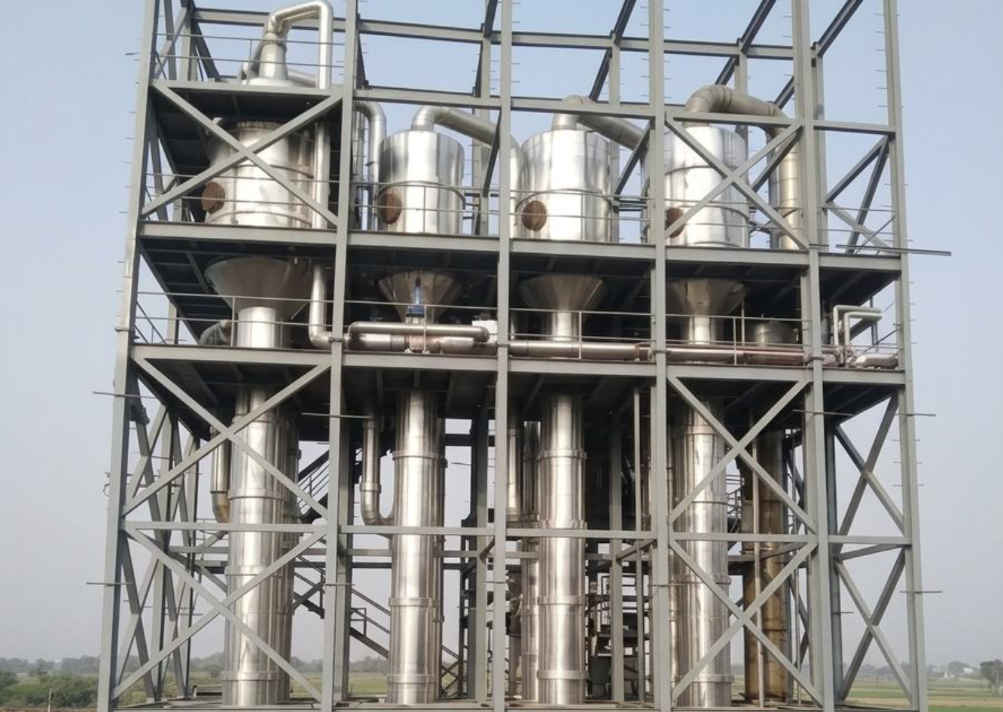
Falling Film
Evaporator

High-efficiency, gentle evaporation for heat-sensitive products. Available in single to 7-effect configurations with optional MVR integration - designed to minimize your steam consumption and maximize product quality.

500 - 50K
L/hr Capacity
1 - 7 Effect
Configuration
SS 316L
Material
ASME
Standard
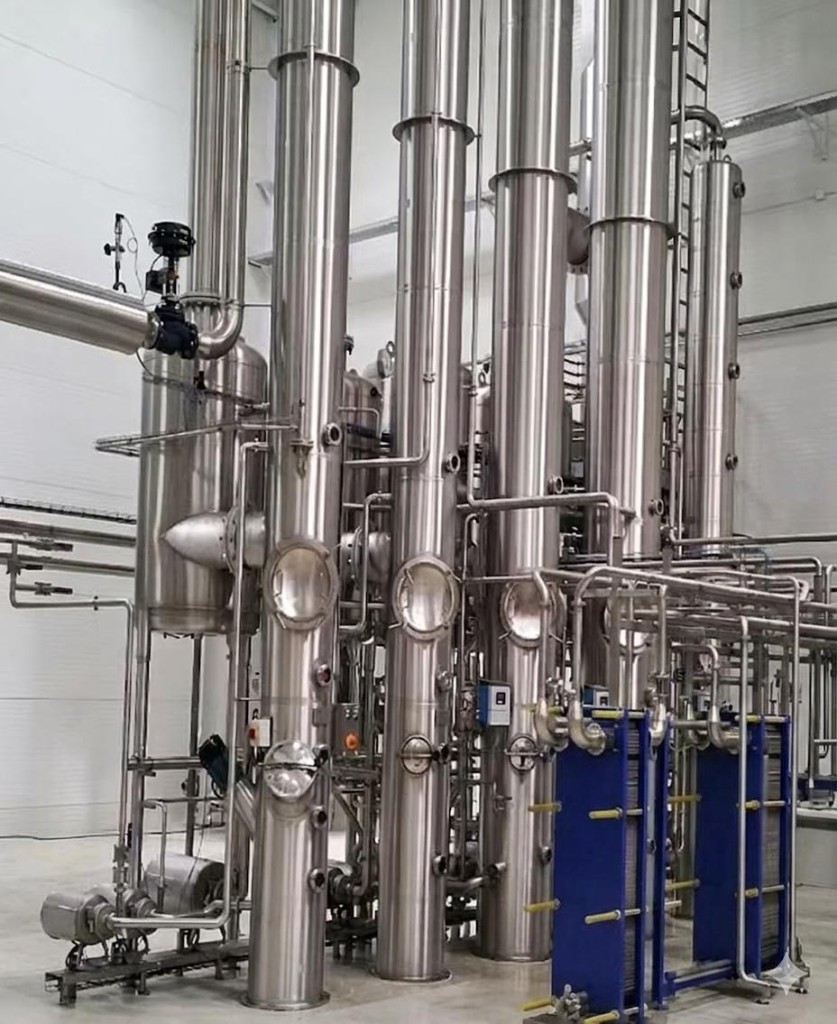
Falling Film Evaporator  -  Gausin International Engineers
Up to 60%
Steam Savings

Product Overview

The Gausin Falling Film Evaporator is a vertically oriented heat exchanger where the liquid feed is distributed uniformly over the top tube sheet and flows downward as a thin film on the inner tube surfaces. Steam or hot water condensing on the shell side supplies the heat required for evaporation.

This design allows evaporation at relatively low temperatures (through vacuum operation), making it ideal for heat-sensitive products like milk, fruit juices, pharmaceutical solutions, and chemical liquids. The short residence time and low temperature difference across the tubes ensure minimal product degradation.

Gausin's FFE systems are engineered using CHEMCAD process simulation and HTRI thermal design software, ensuring precise heat transfer calculations, optimal tube dimensions, and guaranteed performance from day one.

Thin Film Evaporation
Liquid forms a thin, uniform film on tube inner surfaces for maximum heat transfer efficiency.
Low Temperature Operation
Vacuum operation allows evaporation at 40 - 75 deg C - protecting heat-sensitive products.
Multi-Effect Design
Up to 7-effect configurations with vapor reuse between effects for exceptional steam economy.
TVR / MVR Ready
Thermal Vapour Recompression (TVR) / Mechanical Vapour Recompression (MVR) upgrade available for minimum steam consumption.
CIP Compatible
Designed for clean-in-place (CIP) cleaning without dismantling - fully hygienic design.
PLC/SCADA Automation
Full PLC automation with SCADA HMI for precise process control, alarm management, and data logging.

Technical Specifications

Process Parameters

Evaporation Capacity500 to 50,000 L/hr
Number of EffectsSingle / Double / Triple / Up to 7
Operating Temperature40 - 90 deg C (Vacuum)
Operating PressureFull Vacuum to 1.5 bar (g)
Steam Consumption0.14 - 0.45 kg steam/kg water (MEE)
Steam Economy2.2 to 6.5 (2 to 7 Effect)
Outlet ConcentrationUp to 65 - 70% Total Solids
Residence TimeVery Short (Seconds per Pass)

Construction Details

Material of ConstructionSS 304 / SS 316L / Duplex SS
Internal Surface FinishRa <= 0.8 um (Electropolished)
Tube Diameter38 - 51 mm (Standard)
Tube Length4 m / 6 m / 8 m / 10 m / 12 m
Tube-to-Tubesheet JointExpanded + Welded (Seal Weld)
Heating MediumSteam / Hot Water / Vapor
Design PressureAs per ASME Sec. VIII Div.1
Inspection StandardASME / IBR / Third-Party

Instrumentation & Controls

Control SystemPLC / SCADA with HMI Touchscreen
Temperature SensorsPT-100 RTD / Thermocouple (per effect)
Pressure GaugesDiaphragm Type, SS Wetted Parts
Level ControlMagnetic Level Gauge + Level Transmitter
Flow MeasurementElectromagnetic / Coriolis Flow Meters
Density / Brix ControlInline Refractometer / Density Meter
Vacuum SystemSteam Ejector / Liquid Ring Vacuum Pump
CIP ConnectionFull CIP Circuit with Spray Balls

Applications

Dairy Industry
Whole milk, Skim milk, Whey, Lactose, Casein, Sweet and Condensed milk, cream concentration
Fruit Juice
Apple, orange, mango juice concentration while preserving flavor
Pharmaceutical
API solutions and Effluent treatment plant
Chemical
Caustic soda, Dye & Pigments, Effluent, Organic chemicals, polymer solutions
Coffee & Tea
Liquid coffee/tea extract concentration before spray drying
Starch & Sugars
Corn syrup, glucose, starch hydrolysate concentration
Pulp & Paper
Black liquor concentration, pulp mill effluent, and recovery evaporator applications
Distillery
Molasses, spent wash, and ethanol stillage concentration for distillery plants
Nutraceutical
Herbal extracts, botanical concentrates, and functional ingredient processing

Key Advantages

Exceptional Energy Efficiency
Multi-effect design achieves steam economy of 2.2 - 6.5, reducing steam consumption by up to 85% versus single-effect systems. TVR option reduces steam consumption, MVR option virtually eliminates steam requirement.
Gentle Product Treatment
Short residence time (seconds) and low evaporation temperatures protect heat-sensitive components - vitamins, proteins, flavors and colors remain intact.
Wide Capacity Range
Modular design allows capacity from 500 L/hr to 50,000 L/hr in a single unit, with further scale-up through parallel trains.
Continuous Operation
Designed for 24/7 continuous operation with minimal maintenance. Automated CIP cycles keep downtime to a minimum.
Standards Compliance
Manufactured to ASME Section VIII, 3-A sanitary standards (dairy), GMP guidelines (pharma), and all relevant BIS/IS Indian standards.
Low Maintenance
Simple mechanical design with no moving parts in the evaporator body. Predictive maintenance enabled through online monitoring instruments.

How It Works

1
Feed Distribution
The liquid feed is preheated and fed to the top distribution tray of the evaporator. A patented distribution system ensures uniform, even distribution of liquid to all tubes - preventing dry spots and ensuring consistent film formation.
2
Film Formation & Evaporation
The liquid flows downward under gravity as a thin film on the inner tube wall. Steam condensing on the shell side transfers heat through the tube wall to the falling liquid film, causing rapid evaporation of water at the film surface.
3
Vapor-Liquid Separation
At the bottom of the tubes, concentrated liquid and generated vapors exit together and enter the vapor-liquid separator. The separator efficiently separates the vapor (secondary steam) from the concentrated product liquid.
4
Multi-Effect Vapor Reuse
In multi-effect systems, the secondary steam generated in Effect 1 is used as the heating medium for Effect 2 (operating at lower temperature/pressure), and so on. This cascading of vapor energy dramatically reduces total steam consumption.
5
Condensate & Product Discharge
Vapor from the final effect is condensed in a barometric or surface condenser. Steam condensate is recovered and reused. The concentrated product at target Total Solids content is discharged via a density/Brix-controlled outlet pump.
6
Thermo Vapour Recompressor (TVR)
A Thermo Vapour Recompressor (TVR) uses high-pressure motive steam in a steam jet ejector to compress low-pressure vapor from an effect, raising its pressure and temperature so it can be reused as heating steam in the same or preceding effect. This boosts steam economy beyond standard multi-effect operation while keeping investment lower than full MVR systems.
7
Mechanical Vapour Recompressor (MVR)
A Mechanical Vapour Recompressor (MVR) system uses a centrifugal or roots-type compressor driven by an electric motor to compress evaporator vapor, increasing its saturation temperature so the same vapor can serve as the sole heating medium. MVR plants can operate with minimal or zero live steam, delivering the highest energy efficiency for large-capacity falling film evaporators.

Related Products